Thunderbolt 5 has raised the bar for high-speed connectivity, supporting up to 80Gbps of bidirectional bandwidth, up to 120Gbps of display bandwidth with Bandwidth Boost, and up to 240W of power delivery. As high-resolution displays, fast external storage, docking stations, and other demanding peripherals become more common, the cable connecting them has become an increasingly important part of the overall system.
This raises a common question: What is the difference between passive and active Thunderbolt 5 cables?
Silkland recently launched what it describes as the world's first 1.5M passive Thunderbolt 5 cable, now Intel Certified. The product takes a different approach to the length challenge: instead of relying on an active signal-conditioning chip inside the cable, it focuses on improving the cable's own transmission performance.

📍 In this guide:
- Part 1: Thunderbolt 5 Passive vs. Active: What's the Difference?
- Part 2: Why Is a Longer Passive Thunderbolt 5 Cable Difficult?
- Part 3: How Silkland Achieved a 1.5M Passive Thunderbolt 5 Cable?
- Part 4: Intel Certified: Why Certification Matters?
- Part 5: Passive or Active: Which Thunderbolt 5 Cable Should You Choose?
- Part 6: Why 1.5M Passive Matters for Thunderbolt 5?
- FAQ
Part 1: Thunderbolt 5 Passive vs. Active: What's the Difference?
The fundamental difference between passive and active Thunderbolt 5 cables is how they maintain signal integrity.
A passive cable does not use active signal-conditioning electronics inside the cable. The signal travels directly through the cable between the connected devices.
An active cable, by contrast, incorporates electronic components that help maintain signal quality across the transmission path. This makes active designs particularly useful when longer cable runs are required.
Neither architecture is inherently better.
They simply solve the same problem in different ways.
| Passive | Active | |
|---|---|---|
| Active electronics | Direct | Electronically conditioned |
| Cable architecture | Simpler | More complex |
| Longer lengths | More challenging | Better suited |
| Typical advantage | Simpler design | Longer transmission distance |
For shorter connections, passive architecture can provide high-speed connectivity without adding active signal-conditioning electronics to the cable.
The challenge is what happens when you want to make that passive cable longer.
Part 2: Why Is a Longer Passive Thunderbolt 5 Cable Difficult?
Thunderbolt 5 can deliver up to 80Gbps of bidirectional bandwidth. With Bandwidth Boost, it can provide up to 120Gbps of display bandwidth while maintaining 40Gbps upstream bandwidth in supported scenarios.
At these data rates, maintaining signal integrity becomes increasingly demanding./p>
As the transmission path gets longer, engineers have to carefully manage factors including:
- Signal attenuation.
- Impedance.
- Crosstalk.
- Electromagnetic interference.
- Conductor characteristics.
- Shielding.
- Manufacturing consistency.
These factors are closely connected.
A longer cable means a longer path for the signal to travel. That can increase signal loss and make high-frequency signal management more difficult.
An active cable can use electronics inside the cable to help address some of these challenges.
A passive cable cannot.
Instead, the cable itself has to do more of the work.
That makes extending a high-performance passive Thunderbolt 5 cable beyond shorter lengths a significantly more demanding engineering problem.
Part 3: How Silkland Achieved a 1.5M Passive Thunderbolt 5 Cable?
Silkland took a cable-first approach to the challenge.
Rather than relying on an active signal-conditioning chip, the company's 1.5M passive Thunderbolt 5 cable is engineered around the transmission characteristics of the cable itself.
The design uses coaxial signal conductors with silver-plated conductors and 100% shielding coverage.
Each element serves a specific purpose.
Silver-Plated Conductors
At extremely high data rates, conductor characteristics can influence signal loss across the transmission path.
Silkland uses silver-plated conductors in the coaxial signal construction to help minimize signal attenuation and maintain signal quality over the cable's 1.5-meter length.
Coaxial Construction
Coaxial construction helps provide a controlled transmission environment for high-speed signals.
Instead of treating the cable simply as a group of conductors, the structure is designed around the electrical characteristics required for high-speed signal transmission.
This becomes increasingly important as bandwidth and cable length increase.
100% Shielding Coverage
High-speed signals can be affected by electromagnetic interference, particularly in increasingly dense electronic environments.
Silkland's 100% shielding coverage is designed to improve resistance to interference and help protect signal integrity throughout the transmission path.
Together, these design elements allow the cable itself to take on more of the signal-integrity challenge that an active design can address through electronics.
That is the key idea behind Silkland's 1.5M passive Thunderbolt 5 cable.
The goal is not simply to make a passive cable longer. It is to make the cable itself capable of supporting the additional transmission distance.
Part 4: Intel Certified: Why Certification Matters
For Thunderbolt 5, performance is not defined by bandwidth alone.
A certified cable must meet requirements covering areas such as signal integrity, power delivery, and device compatibility.
Silkland's 1.5M passive Thunderbolt 5 cable has now received Intel certification, providing independent validation that the cable meets the requirements of the Thunderbolt 5 ecosystem.

The cable supports the core Thunderbolt 5 performance profile, including 80Gbps bidirectional bandwidth and the Thunderbolt 5 Bandwidth Boost capability for up to 120Gbps of display bandwidth while maintaining 40Gbps upstream bandwidth in supported configurations.
This certification is particularly meaningful for a passive cable.
The cable does not rely on an active signal-conditioning chip to achieve its performance. Instead, the required signal integrity has to be maintained through the cable's own construction and engineering.
That is what makes the combination of 1.5M + Passive + Thunderbolt 5 + Intel Certified notable.
Part 5: Passive or Active: Which Thunderbolt 5 Cable Should You Choose?
The right choice depends primarily on the length and requirements of your setup.
A passive cable may be the better fit if you:
- Need a cable around 1–1.5 meters.
- Prefer a simpler cable architecture.
- Want high-bandwidth Thunderbolt 5 connectivity without active electronics inside the cable.
- Are building a desktop, gaming, creator, or workstation setup.
- Do not need a long cable run.

Silkland Premium Thunderbolt 5 Passive Cable 1.5M
An active cable may be the better fit if you:
- Need a longer cable.
- Need to position a monitor, dock, or storage device farther away.
- Prioritize cable length for your setup.
The key takeaway is simple:
Active and passive cables are different engineering solutions, not different performance tiers.
Active designs are particularly useful when longer transmission distances are required. Passive designs offer a simpler signal path, but extending them to longer lengths places greater demands on the cable itself.
For users who need around 1.5 meters of high-performance Thunderbolt 5 connectivity, a passive design can therefore offer an interesting combination of reach and architecture.
Part 6: Why 1.5M Passive Matters for Thunderbolt 5?
Thunderbolt 5 is pushing connectivity toward higher bandwidth, higher-resolution displays, faster external storage, and increasingly capable docking solutions.
As performance increases, cable engineering becomes more important.
Active technology provides an effective way to extend high-speed connectivity over longer distances. But advances in conductor design, coaxial construction, shielding, and manufacturing precision can push passive technology further as well.
Silkland's 1.5M passive Thunderbolt 5 cable represents that approach.
It is not simply a longer version of a shorter passive cable.
It is an attempt to extend the practical range of passive Thunderbolt 5 connectivity while maintaining the performance required by the standard.
And with Intel certification now in place, the result is not just an engineering concept.
It is a certified Thunderbolt 5 cable designed for real-world high-performance setups.
Sometimes, the breakthrough is not adding more electronics. It is making the cable itself do more.
FAQ
Q1. What is the difference between passive and active Thunderbolt 5 cables?
A passive Thunderbolt 5 cable does not use active signal-conditioning electronics inside the cable. An active cable uses electronic components to help maintain signal integrity, particularly over longer transmission distances.
Q2. Is a passive Thunderbolt 5 cable slower than an active cable?
Not necessarily. Passive and active cables use different engineering approaches to maintain signal integrity. A properly designed passive cable can deliver the performance required by Thunderbolt 5 within its intended specifications.
Q3. Why are longer Thunderbolt 5 cables often active?
As cable length increases, maintaining signal integrity at very high data rates becomes more difficult. Active electronics provide one established way to help manage signal degradation over longer transmission paths.
Q4. Why is a 1.5M passive Thunderbolt 5 cable difficult to make?
A longer passive transmission path increases the challenges associated with signal attenuation, impedance, crosstalk, electromagnetic interference, and manufacturing consistency. Without active electronics inside the cable, more of the signal-integrity burden falls on the cable's own construction.
Q5. Is Silkland's 1.5M passive Thunderbolt 5 cable Intel Certified?
Yes. Silkland's 1.5M passive Thunderbolt 5 cable has received Intel certification.
Conclusion
As Thunderbolt 5 continues to push the limits of high-speed connectivity, cable design will continue to evolve with it. Silkland's 1.5M passive Thunderbolt 5 cable is one example of how far passive connectivity can go.
Experience Silkland's Premium Thunderbolt 5 Cables >>
RELATED PRODUCTS
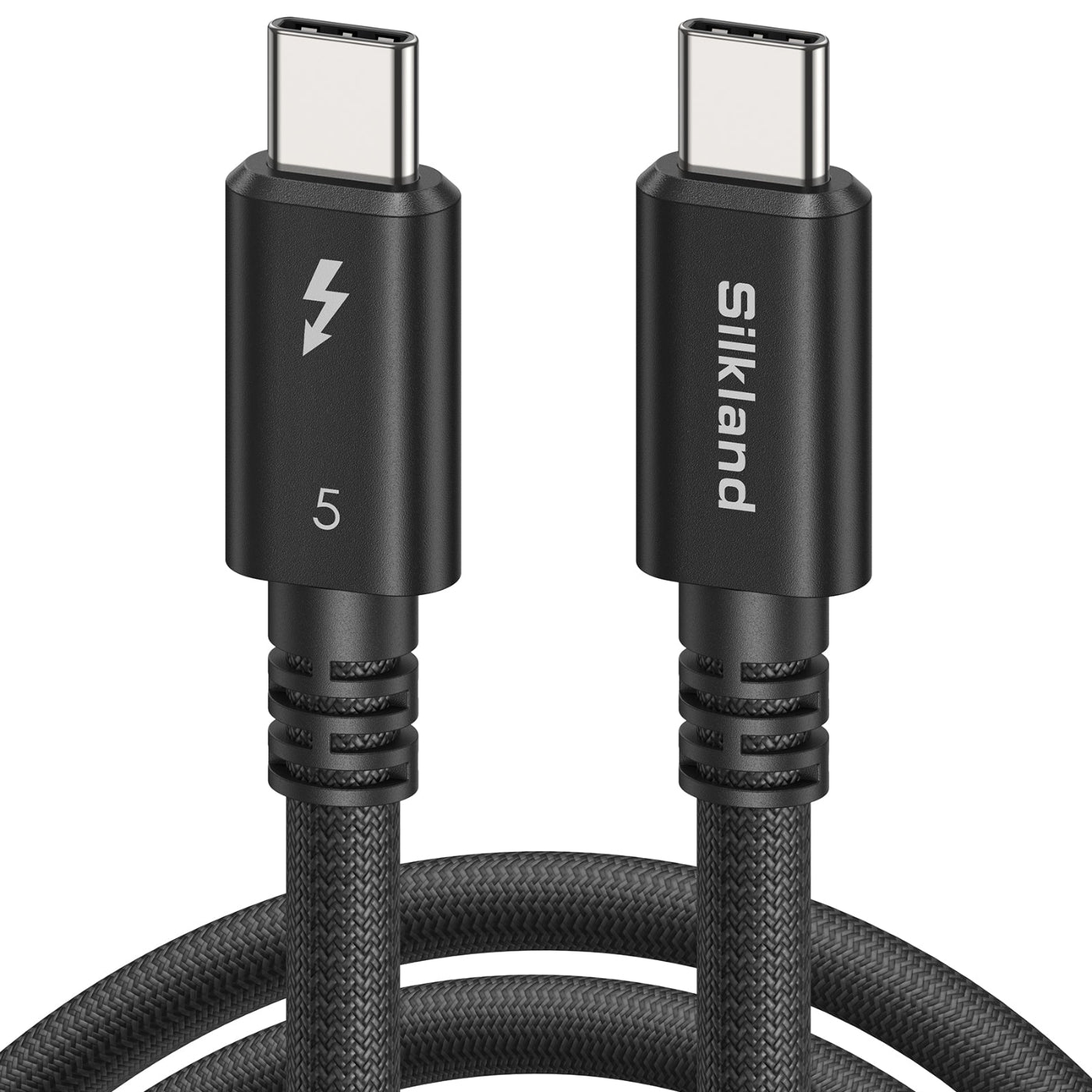
Silkland Passive 1.5M/5FT Thunderbolt 5 Cable
Silkland's Intel-Certified 1.5M Passive Thunderbolt 5 cable combines advanced silver-plated coaxial construction and 100% shielding to minimize signal loss and interference—delivering up to 80Gbps bidirectional bandwidth, 120Gbps Bandwidth Boost, and 240W power delivery.

Silkland Thunderbolt 5 Cable 80Gbps, 3.3FT
Intel-Certified Thunderbolt 5 cable delivers up to 80Gbps bidirectional data, 120Gbps display bandwidth, 16K support, and 240W charging in a durable, widely compatible design built for demanding professional and gaming setups.
Share:
USB-C 3.2 vs 3.1 vs 2.0: What's the Difference and Which One Do You Need?
Silkland Launches the World’s First Certified Ultra96 HDMI Cable Available to Consumers